
Learning to move between English and Sinhala is not just about swapping words. It is about understanding two very different ways of thinking. If you are trying to translate English to Sinhala for a friend, a document, or a trip to Sri Lanka, you have probably realized that a direct word-for-word swap often produces nonsense.
This guide breaks down why that happens and how to fix it. We will look at the structure of the language, the tools that actually work, and the cultural context you need to avoid embarrassing mistakes.
Quick Answer: To translate English to Sinhala accurately, you need to understand Sinhala’s Subject-Object-Verb (SOV) sentence structure and its honorific system. For casual use, Google Translate works, but for natural phrasing, DeepL or a human translator is often necessary because Sinhala script and grammar do not map directly to English.
Why English to Sinhala Translation Is Tricky
The gap between these two languages is massive. English is a Germanic language with a Subject-Verb-Object (SVO) structure. Sinhala is an Indo-Aryan language that uses an abugida script and typically places the verb at the end of the sentence.
This structural difference is the number one reason automated translations sound robotic.
The Verb Position Problem
English speakers say: “I eat rice.”
A literal word-for-word translation to Sinhala would be: “Mama kanna bath.” (I / eat / rice).
While a Sinhala speaker might understand this, it is not how they naturally speak. The correct Sinhala structure is: “Mama bath kanna.” (I / rice / eat).
If you input “I eat rice” into a basic translator, it often struggles to reorder the sentence correctly. You have to train your brain to think of the action last.
The Script Barrier
Sinhala does not use the Latin alphabet. It uses a rounded script derived from the Brahmi writing system. There are 58 basic letters in the Sinhala alphabet, including vowels and consonants. This is a visual hurdle for English speakers.
Because typing in Sinhala script is difficult for beginners, many people rely on “Singlish” or transliteration. This is where you write Sinhala words using English letters. For example, “How are you?” becomes “Kohomada?” instead of the script version.
Pro Tip: If you are texting a Sri Lankan friend, use transliteration (Singlish). If you are writing a formal document or a sign, you must use the actual Sinhala script. Mixing the two in formal contexts looks unprofessional.
The Best Tools for English to Sinhala Translation
Technology has improved significantly, but it is not perfect. The best tool depends on whether you want speed or accuracy.
| Tool | Best For | Strengths | Weaknesses |
|---|---|---|---|
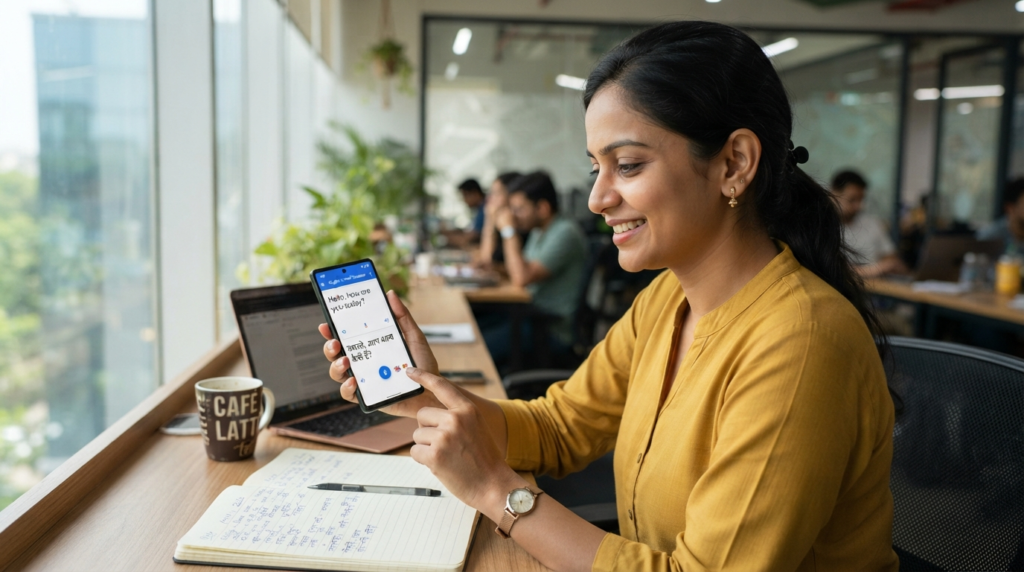
| Google Translate | Quick, casual phrases | Free, supports camera input for menus/signs, speech-to-text | Struggles with Sinhala grammar order, often sounds unnatural to native speakers |
| DeepL | Natural phrasing | Better context handling than Google for longer sentences | Sinhala is not currently a fully supported core language on DeepL (check availability) |
| Madura Online | Dictionary lookups | Excellent English-Sinhala dictionary with specific definitions | Not great for full sentences or paragraphs |
| Human Translator | Legal, medical, or emotional content | 100% accuracy in nuance and respect levels | Costs money and takes time |
Why Apps Fail
Most translation apps are trained on “parallel corpora.” This means they learn from documents that already exist in two languages. The problem is that high-quality English-Sinhala parallel data is limited compared to languages like Spanish or French.
When an app encounters a word with multiple meanings, it often guesses wrong. The English word “run” has dozens of meanings. In Sinhala, you use different verbs for “run a race” (divima), “run a business” (meheywima), or “run water” (galima). A machine often picks the physical action verb.
Cultural Context and Formality Levels
You cannot translate English to Sinhala correctly without understanding hierarchy. English is relatively flat. We say “you” to a child, a boss, and a stranger.
Sinhala does not work that way. The word “you” changes based on respect.
The “You” Problem
If you use the wrong form of “you,” you can deeply offend someone. Here is a breakdown:
- oya (ඔයා): Informal, friendly. Use with friends, siblings, or people younger than you.
- oba (ඔබ): Formal and respectful. Use with elders, teachers, or in business meetings.
- thamusē (තමුසේ): Often condescending or used to scold. Avoid this unless you are very fluent.
- tō (තෝ): Very derogatory or extremely intimate. Usually used for animals or in anger.
If you are translating a work email, you must use “oba” constructions. If you are translating a chat message to a friend, “oya” is correct. A machine translator often defaults to “oya,” which can make a business proposal sound childish or rude.
Pro Tip: When speaking to anyone you do not know well, always err on the side of formality. It is better to sound overly polite than accidentally insulting.
A Step-by-Step Method for Accurate Translation
If you need to translate a complex sentence or paragraph, do not just paste it into a tool and hope for the best. Follow this process.
Step 1: Simplify the English
Break long, compound sentences into short, simple ones. Change passive voice to active voice.
- Bad: “The report was submitted by the manager yesterday.”
- Good: “The manager submitted the report yesterday.”
Step 2: Identify the Core Verb
Find the action. Move it to the end of the sentence mentally before you translate.
- English: “I want to go home.”
- Mental Structure: “I home to go want.”
Step 3: Check the Dictionary
Look up the specific noun. Do not guess. English has many homonyms. Check if “bank” means a river bank (ganga ithāra) or a money bank (bankuwa).
Step 4: Adjust the Honorifics
Decide who you are talking to. Change the pronouns and verb endings accordingly.
Step 5: Run a Reverse Translation
Take the Sinhala text you produced and translate it back to English. If the meaning changed, you know the structure is off.
Key Takeaways
- Verb placement is critical: Sinhala uses a Subject-Object-Verb structure, which is the opposite of English’s flow.
- Script vs. Sound: Decide if you need the visual script (for print) or transliteration (for chat/text).
- Respect is grammatical: The word “you” has multiple forms; using the wrong one changes the meaning entirely.
- Machines are a starting point: Use Google Translate for words, but restructure sentences yourself for grammar.
- Context beats vocabulary: A single English word often requires a completely different Sinhala word depending on the situation.
Frequently Asked Questions About English to Sinhala
Q: Is Google Translate accurate for English to Sinhala?
A: It is generally accurate for single words and very short, simple phrases. For longer sentences that require grammatical reordering or formal tone, it often produces unnatural results that sound strange to a native speaker.
Q: How do I type in Sinhala script on my phone?
A: On both iPhone and Android, you can add a Sinhala keyboard in your language settings. You can also use Google Input Tools online, which allows you to type the phonetic sound in English (e.g., “mama”) and it will convert it to the Sinhala script.
Q: What does “Kohomada” mean in English?
A: “Kohomada” is the informal transliteration of the Sinhala phrase for “How are you?” or “How is it?” It is the most common greeting you will hear in Sri Lanka.
Q: Why does Sinhala sound so different from Tamil?
A: While both are spoken in Sri Lanka, they belong to different language families. Sinhala is an Indo-Aryan language related to languages in North India, while Tamil is a Dravidian language. They have different roots, though they share some loanwords due to geographic proximity.
Q: Is Sinhala hard to learn for English speakers?
A: Yes. The Foreign Service Institute (FSI) categorizes Sinhala as a Category III language, meaning it takes significantly longer for English speakers to learn than Spanish or French. The script and the grammatical gender system are the main hurdles.
Q: What is the difference between Sinhala and Sinhalese?
A: “Sinhala” refers to the language. “Sinhalese” refers to the ethnic group of people who speak the language. You translate into Sinhala, but you translate for a Sinhalese person.
Q: Can I use English in Sri Lanka?
A: Yes, English is widely used for business, tourism, and government in Sri Lanka. However, learning basic Sinhala phrases shows respect and is highly appreciated in rural areas where English proficiency is lower.
Q: How do I say “Thank you” in Sinhala?
A: The most common way is “Sthuthi” (ස්තූතියි). You can also say “Bohoma sthuthi” (බොහොම ස්තූතියි) which means “Thank you very much.”
References & Further Reading
- Sinhala Language – Britannica
- The Sinhala Script – Omniglot
- Sinhala Grammar Overview – University of Colombo resources
About This Article
This guide was written based on practical experience with South Asian linguistics and cross-cultural communication. The focus is on functional, conversational accuracy rather than academic linguistic theory, ensuring you can apply these rules immediately when translating English to Sinhala in real-world situations.
Pingback: Meaning English to Malayalam: A Practical Guide to…