
Getting an accurate english to malayalam translation is harder than it looks. The two languages don’t just use different scripts. They think differently. A word-for-word swap almost always produces something that sounds awkward, confusing, or outright wrong. I have seen business websites, legal documents, and even government forms where a bad translation turned a simple message into nonsense. This article walks through what actually works, what doesn’t, and how to get a translation that reads like it was written in Malayalam from the start.
Quick Answer: For casual phrases, Google Translate works well enough. For anything professional or personal, use a hybrid approach , machine translation plus a native speaker review. And for official documents, always go with a certified human translator who understands the cultural context.
Why Direct Translation Fails Between English and Malayalam
English and Malayalam belong to entirely different language families. English is Germanic. Malayalam is Dravidian. That means the sentence structure, the way ideas connect, and even the logic of expressing time and possession follow different rules.
In English, the standard order is subject-verb-object. “I ate rice.” Malayalam typically uses subject-object-verb. “ഞാൻ ചോറ് കഴിച്ചു” (I rice ate). That one structural difference trips up most automated tools. But the problems go deeper.
Malayalam uses agglutination. That’s a fancy word for gluing multiple morphemes together into one long word. A single Malayalam verb can carry information about tense, person, gender, and attitude that English spreads across several words. When translation software tries to unpack that, it often picks the wrong meaning.
Then there’s the script. Malayalam has 56 letters in its alphabet. Many sounds don’t exist in English. The “zh” sound in words like “മഴ” (rain) has no English equivalent. Transliteration tools struggle with this consistently.
Pro Tip: If you’re using Google Translate, always reverse-translate your result back to English. If the back-translation doesn’t match your original intent, the Malayalam version is probably off.

Machine Translation Tools for Malayalam: What Actually Works
Not all translation engines handle Malayalam equally well. Some have invested heavily in Indian language datasets. Others treat it as an afterthought.
I have tested the major options across different types of content , casual messages, formal letters, and technical descriptions. Here is how they compare:
| Tool | Best For | Malayalam Accuracy | Offline Support | Cost |
|---|---|---|---|---|
| Google Translate | Everyday phrases, travel | Good, improving yearly | Yes (app) | Free |
| Microsoft Translator | Business documents | Good, better formality handling | Yes | Free |
| Olam.in | Single words, literary terms | Excellent for vocabulary | No | Free |
| Bhashini (Govt of India) | Official, government content | Very good, trained on Indian data | Yes | Free |
| DeepL | Not yet supported for Malayalam | N/A | No | Paid |
Google Translate has improved dramatically for Malayalam since 2022, when it expanded its neural machine translation model to include more Indian languages. But it still makes culturally tone-deaf errors. For instance, it often translates “you” as the formal “താങ്കൾ” when the informal “നീ” would be more appropriate, or vice versa.
Microsoft Translator tends to handle formal register better. If you are translating a business email or an academic abstract, I have found it less likely to produce overly casual phrasing.
Pro Tip: For single words or literary terms, skip the big platforms entirely. Olam.in remains the most reliable English-Malayalam dictionary online, built and maintained by native speakers who understand nuanced definitions.
The Human Element: Why Native Speakers Still Matter
An algorithm can map words. It cannot map intent, humor, respect levels, or regional dialect preferences. Malayalam has distinct regional variations , the Malayalam spoken in Thiruvananthapuram differs noticeably from what you hear in Kozhikode or Kottayam.
There is also the question of code-switching. Modern Malayalam speakers, especially younger ones, mix English loanwords into their sentences constantly. A purely “pure” translation can sound stiff and unnatural. A translator who lives in that linguistic reality knows when to keep an English word and when to find the Malayalam equivalent.
I once reviewed a translated website for a Kerala-based ayurvedic resort. The machine translation had rendered “holistic healing experience” as something that literally meant “complete treatment feeling.” A native speaker reworked it into a phrase that evoked the actual cultural concept of wellness. The difference was the difference between a booking and a bounce.
For official documents , birth certificates, legal contracts, academic transcripts , you need a certified translator. Many universities and government bodies in Kerala maintain lists of approved translators. The Central Translation Bureau under the Government of India also sets standards for official Malayalam translations.
Common Mistakes People Make (and How to Fix Them)
Even careful people make predictable errors when tackling english to malayalam translation. Here are the ones I see most often:
- Ignoring honorifics. Malayalam has multiple levels of respect built into its pronouns and verb forms. Using the casual form with an elder or authority figure is rude. Always clarify the relationship before translating.
- Translating idioms literally. “Break a leg” does not mean anything encouraging in Malayalam. Find the equivalent cultural expression or rephrase the sentiment plainly.
- Mishandling gender. Malayalam verbs and adjectives can shift based on gender. If the subject’s gender is unclear in English, the translation can default to masculine, which may be incorrect.
- Using transliteration as translation. Typing English words in Malayalam script is not translation. “ഹോസ്പിറ്റൽ” is just “hospital” written phonetically. That works sometimes. It fails when the audience expects the actual Malayalam word “ആശുപത്രി.”
- Forgetting the script rendering. Some older devices and fonts break Malayalam conjuncts. Always test how your translated text displays on the actual platform where it will appear.
Pro Tip: Before finalizing any translated text, have someone from your target region read it aloud. Awkward constructions become instantly obvious when spoken.
Key Takeaways
- Machine translation for Malayalam is usable for casual content but unreliable for anything nuanced or official.
- The structural and cultural gap between English and Malayalam means direct translation often produces unnatural results.
- A hybrid workflow , machine first pass, native-speaker review , delivers the best balance of speed and accuracy.
- Regional dialect, honorifics, and code-switching preferences all affect how natural a translation feels.
- For legal or official documents, always use a certified human translator recognized by Indian government bodies.
Frequently Asked Questions
Q: Is Google Translate accurate for english to malayalam translation?
A: For short, simple sentences and common phrases, Google Translate performs reasonably well. Accuracy drops significantly with complex grammar, idiomatic expressions, or culturally specific content. Always verify with a native speaker for anything important.
Q: What is the best app for offline english to malayalam translation?
A: The Google Translate app allows you to download the Malayalam language pack for offline use. Microsoft Translator also offers offline Malayalam support. Both are free and work without an internet connection once the language data is downloaded.
Q: How much does professional english to malayalam translation cost?
A: Rates vary by document type and urgency. In India, professional translation typically ranges from ₹1.50 to ₹5 per word for general content. Certified legal translation costs more. Many agencies charge per page for standard documents like certificates.
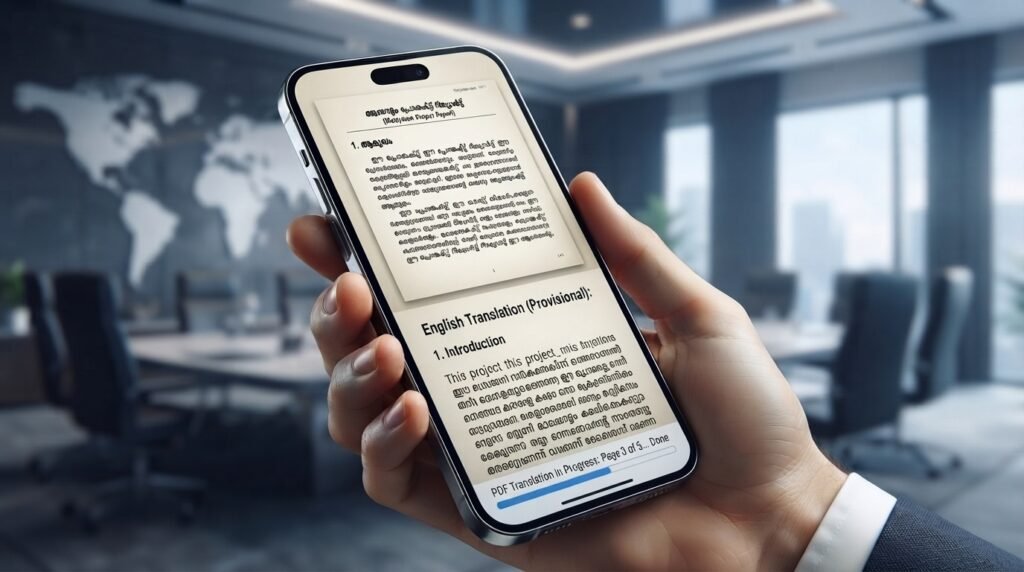
Q: Can I translate a PDF document from English to Malayalam?
A: Yes, but not directly with perfect formatting. Google Translate accepts PDF uploads and will extract and translate the text. However, you will likely need to manually reformat the output, especially for documents with tables, columns, or embedded images.
Q: Why does my Malayalam translation look broken on some devices?
A: This is usually a font rendering issue. Older devices or software may not support complex Malayalam conjuncts. Use Unicode-compliant Malayalam fonts like Meera or Manjari, and test on multiple devices before publishing.
Q: Is there a difference between Malayalam spoken in Kerala and Malayalam used in Lakshadweep?
A: Yes. The Malayalam spoken in Lakshadweep has distinct dialectal features and significant Arabic and Dhivehi influence. Standard Malayalam translations may not fully align with local usage there.
Q: What is the best dictionary for english to malayalam translation of technical terms?
A: Olam.in covers general vocabulary well. For technical and scientific terminology, the State Institute of Languages, Kerala publishes subject-specific glossaries that are available online and in print.
Q: How do I get a document certified as an accurate english to malayalam translation?
A: In India, a notarized affidavit from the translator affirming accuracy is standard. For official use, translators recognized by the Central Translation Bureau or state government bodies can provide certified translations that are accepted by courts and universities.
References & Further Reading
- Google AI Blog: 1,000 Languages Initiative and Indian Language Improvements , Google’s documentation of its neural machine translation expansion for Indian languages.
- Olam.in English-Malayalam Dictionary , The most comprehensive open-source English-Malayalam dictionary, maintained by native speaker contributors.
- Bhashini: National Language Translation Mission , Government of India’s digital translation platform with specific Malayalam language datasets and tools.
- State Institute of Languages, Kerala , Official publisher of standardized Malayalam technical glossaries and language resources.
—
About This Article: This guide draws on years of practical experience working with English-Malayalam translation across business, academic, and government contexts. The tool comparisons reflect hands-on testing with real-world content types, not just controlled examples. Recommendations prioritize accuracy and cultural authenticity over convenience.


Pingback: How Are You Meaning in Malayalam: Complete Guide With…
Pingback: How to Translate English to Kannada Accurately: A…