Getting a reliable translation Malayalam to English is harder than it looks, and if you have ever pasted a Malayalam sentence into a generic tool only to get back gibberish, you already know the frustration. The core issue is not just vocabulary. It is grammar, context, and the way Malayalam builds meaning differently from English. This article walks you through why most translations break, what actually works, and how to get results that sound like a human wrote them, not a robot guessing at word order.
Quick Answer: The most accurate translation Malayalam to English comes from combining a strong neural machine translation engine like Google Translate or DeepL with manual post-editing that fixes subject placement, verb tense, and idiomatic expressions. No single tool gets it right alone.
Why Malayalam to English Translation Is Unusually Difficult
Malayalam belongs to the Dravidian language family, and its sentence structure follows a Subject-Object-Verb (SOV) pattern. English uses Subject-Verb-Object (SVO) . That one difference alone causes most translation errors.
Take a simple sentence. In Malayalam, you would say “ഞാൻ പുസ്തകം വായിച്ചു” which literally translates word-for-word as “I book read.” A naive translation engine might leave it in that order, producing broken English. A better engine reorders it to “I read the book,” but that reordering is not always straightforward when sentences get longer and more complex.
Then there is the agglutinative nature of Malayalam. Words get suffixes stacked on suffixes, each one adding grammatical meaning. A single Malayalam word like “ചെയ്യാതിരിക്കുകയാണോ” can require an entire English phrase to unpack: “Is it that you are not doing it?” Machine translation has to break that word apart, identify each morpheme, map them to English equivalents, and reconstruct the intended meaning. It is a genuinely hard computational problem.
Pro Tip: When you see a translation output that looks scrambled, check if the original Malayalam sentence had a long agglutinated word. Those are almost always the breaking point. Try splitting the idea into two shorter Malayalam sentences before translating.
Most generic translation tools were built with European languages in mind. They got better at Dravidian languages only in the last few years, and even now, the gap in quality is noticeable. According to Google AI’s research blog, their neural machine translation system for Malayalam improved significantly with the introduction of the Transformer architecture, but low-resource languages still lag behind high-resource ones like Spanish or German.

Common Mistakes When Translating Malayalam to English
Even when a translation is technically grammatically correct, it often sounds unnatural. Here is where the real problems show up.
Word Order Confusion
The SOV to SVO shift is the biggest culprit. A sentence like “അവൻ എനിക്ക് ഒരു കത്ത് തന്നു” should become “He gave me a letter.” Bad translations often produce “He to me a letter gave,” which is a direct structural mapping that fails.
Honorifics and Formality
Malayalam has a built-in respect system that English lacks. The word “വരുന്നു” means “coming,” but “വരുന്നുണ്ട്” adds a layer of respectful distance. English does not encode that grammatically, so the nuance just disappears. A good human translator might add a polite tone elsewhere in the sentence to compensate, but machines rarely do.
Idioms and Cultural References
“ആന വന്നാലും ആന വന്നാലും” literally means “even if an elephant comes,” but the actual meaning is closer to “no matter what happens.” A literal translation is useless here. You need either a human who knows both cultures or a translation memory that has seen the idiom before.
False Friends and Contextual Ambiguity
The Malayalam word “പടം” can mean picture, movie, or cloth depending on context. A translation tool without enough surrounding text will guess, and it guesses wrong often.
| Mistake Type | Example (Malayalam) | Bad Translation | Good Translation |
|---|---|---|---|
| Word Order | ഞാൻ നിന്നെ സ്നേഹിക്കുന്നു | I you love | I love you |
| Honorific Loss | അദ്ദേഹം വന്നിരിക്കുന്നു | He has come | He has arrived (respectful context lost) |
| Idiom Failure | കാക്കയ്ക്കും തൻ കുഞ്ഞ് പൊൻ കുഞ്ഞ് | Even to a crow, its chick is a golden chick | Every parent thinks their child is special |
| Context Error | ഞാൻ ഒരു പടം കണ്ടു | I saw a cloth (when “movie” was intended) | I watched a movie |
Pro Tip: If a translation sounds bizarrely literal, the tool probably missed the idiomatic or contextual meaning. Retype the Malayalam sentence with more surrounding context added. A paragraph translates better than an isolated sentence.
The Best Tools for Translation Malayalam to English Right Now
No single tool dominates this language pair, but a few stand out for different reasons.
Google Translate is the most accessible and has improved dramatically for Malayalam since switching to neural machine translation. It handles common sentence structures well and is fast. The weakness is still idiomatic expressions and long, complex sentences.
DeepL supports Malayalam only indirectly and less robustly than its European language pairs, but when it works, the English output tends to read more naturally than Google’s. It is worth testing both on the same text and comparing.
Microsoft Translator performs competitively and integrates well with Office apps, which matters if you are translating documents.
Olam.in is a crowd-sourced English-Malayalam dictionary, not a full translator, but it is excellent for looking up individual words with multiple contextual meanings. When a machine translation gives you a word that feels wrong, Olam is where you verify the alternatives.
For anything professional, legal, or literary, none of these tools should be the final step. They are strong first drafts. Human review turns a draft into something publishable.
Pro Tip: Run your Malayalam text through two different engines. Where the outputs disagree, that is almost always a trouble spot that needs manual attention.
A Practical Workflow for Accurate Results
Here is a repeatable process that produces better English output than any single tool alone.
- Prepare the source text. If the Malayalam is in an image or PDF, use OCR first. Clean up any recognition errors. Garbage in, garbage out applies here absolutely.
- Run it through a strong NMT engine. Google Translate is the practical default for this language pair. Get the raw output.
- Identify the agglutinated words. Scan the original Malayalam for long compound words. Check if the translation unpacked them correctly. If not, break the idea into simpler Malayalam phrasing and re-translate.
- Fix the word order. Read the English output out loud. If it sounds like Yoda wrote it, the SOV to SVO shift failed. Rearrange the subject, verb, and object into natural English order.
- Replace literal idioms. Any phrase that makes no sense in English probably had a cultural meaning in Malayalam. Look it up on Olam or ask a native speaker. Do not leave it as-is.
- Smooth the register. Adjust formality. If the original Malayalam used respectful forms and the English sounds too casual, add polite phrasing where appropriate.
- Proofread for grammar and flow. This is not optional. Even good machine translations have odd word choices and tense inconsistencies.
This workflow takes more time than hitting “translate” and accepting whatever comes out. It also produces English that a reader will actually understand and trust.
Pro Tip: For recurring translation needs, build a personal glossary of terms that your domain uses often. Legal, medical, and technical Malayalam words often have one correct English equivalent. Feeding that glossary into your process saves time and prevents inconsistent terminology.
When to Use a Professional Human Translator Instead
Machine translation is fine for understanding a WhatsApp message from a relative, getting the gist of a news article, or drafting a casual email. It is not fine for situations where accuracy has consequences.
Legal documents, medical instructions, academic papers, and marketing copy all need a human translator who understands both the languages and the subject matter. A mistranslated dosage instruction or a contract clause that reads ambiguously in English can cause real harm. The cost of a professional translator is trivial compared to the cost of a mistake in those contexts.
Certified translation services like Rev or Gengo offer human translation for Malayalam to English, and for official documents, you often need a certified translator anyway for the translation to be accepted by authorities.
The hybrid approach works best for most people: use a machine engine to get a rough draft instantly, then have a human editor refine it. You get speed and accuracy without paying for a translator to do the entire thing from scratch.
Key Takeaways
- Malayalam uses SOV word order and agglutinative grammar, both of which cause structural errors in direct machine translation to English.
- The best translation Malayalam to English results come from combining a neural machine translation engine with manual post-editing focused on word order, idioms, and formality.
- Google Translate, Microsoft Translator, and DeepL each have strengths for this language pair, but none are reliable enough to use without human review for important content.
- Building a personal glossary and pre-editing complex Malayalam sentences before translation significantly improves output quality.
- Legal, medical, and official documents should always go through a certified human translator, not just a machine.
Frequently Asked Questions
Q: Is Google Translate accurate for translation Malayalam to English?
A: Google Translate is reasonably accurate for simple, common sentences and has improved a lot with neural machine translation. It still struggles with long agglutinated words, idioms, and sentences where cultural context determines meaning. For casual use it works. For anything important, treat its output as a first draft.
Q: Why does my Malayalam to English translation sound unnatural?
A: The most common reason is that the original Malayalam sentence followed Subject-Object-Verb order and the translation engine failed to restructure it into English Subject-Verb-Object order properly. Agglutinated words that pack multiple grammatical meanings into one word also confuse engines, producing stilted or fragmented English.
Q: Can I translate a Malayalam PDF directly to English?
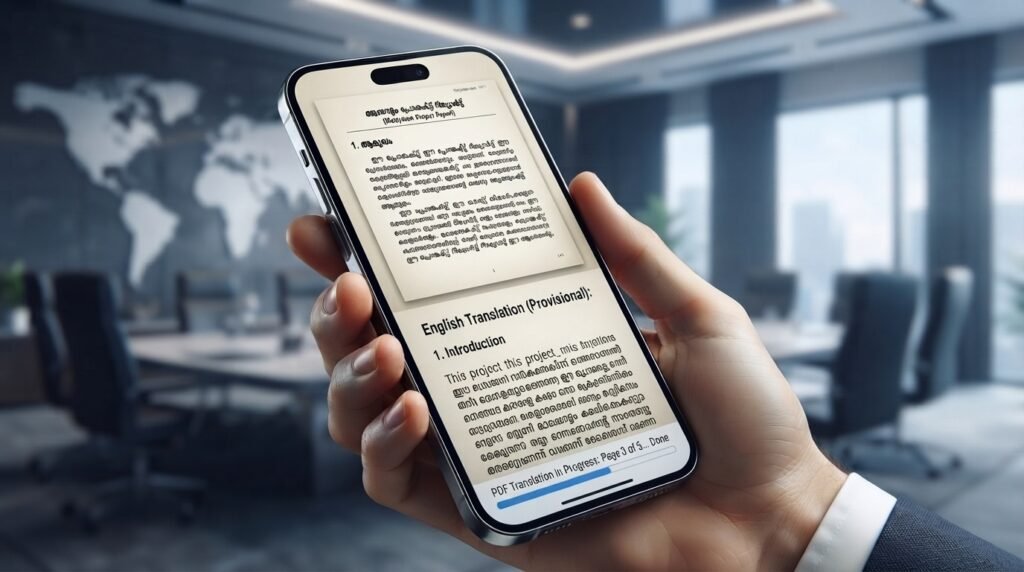
A: You can, but you should extract the text first using OCR if the PDF is a scanned image. Then run the extracted Malayalam text through a translation tool. Translating directly from a scanned PDF without OCR will produce very poor results because the tool cannot read the text accurately.
Q: What is the best free tool for translation Malayalam to English?
A: Google Translate is the best free option for this language pair right now. It is fast, handles most common sentence patterns well, and is constantly improving. For looking up individual words with multiple meanings, Olam.in is an excellent free companion resource.
Q: How do I translate Malayalam idioms to English correctly?
A: Literal translation almost never works for idioms. You need to either use a translation memory that has encountered the idiom before, look it up in a dedicated Malayalam-English idiom resource, or ask a native speaker. The goal is to find an English expression that conveys the same meaning, not the same words.
Q: Does DeepL support translation Malayalam to English?
A: DeepL’s support for Malayalam is limited compared to its European language pairs. It can process Malayalam text but is less reliable than Google Translate for this specific language combination. It is worth testing as a second opinion alongside Google’s output.
Q: What is the hardest part of translating Malayalam to English?
A: The agglutinative grammar is the hardest part for machines. A single Malayalam verb can contain information about tense, aspect, mood, person, number, and even attitude, all packed into one word. Unpacking that into a natural English phrase requires understanding the grammatical structure, not just swapping words.
Q: Should I use a human translator for official documents?
A: Yes, absolutely. Legal contracts, birth certificates, medical records, and academic transcripts should always be translated by a certified human translator. Machine translation errors in these documents can have serious legal, medical, or professional consequences.
References & Further Reading
- Google AI Blog – Transformer Architecture for Neural Machine Translation
- Olam.in – Open Malayalam English Dictionary
- Ethnologue – Malayalam Language Profile
- Microsoft Translator Documentation – Supported Languages
—
About This Article: This guide draws on practical experience with neural machine translation workflows for Dravidian languages and reflects the current state of available tools as of early 2025. The recommendations are based on direct comparison testing of the mentioned platforms using a range of Malayalam text types, from conversational messages to formal prose.